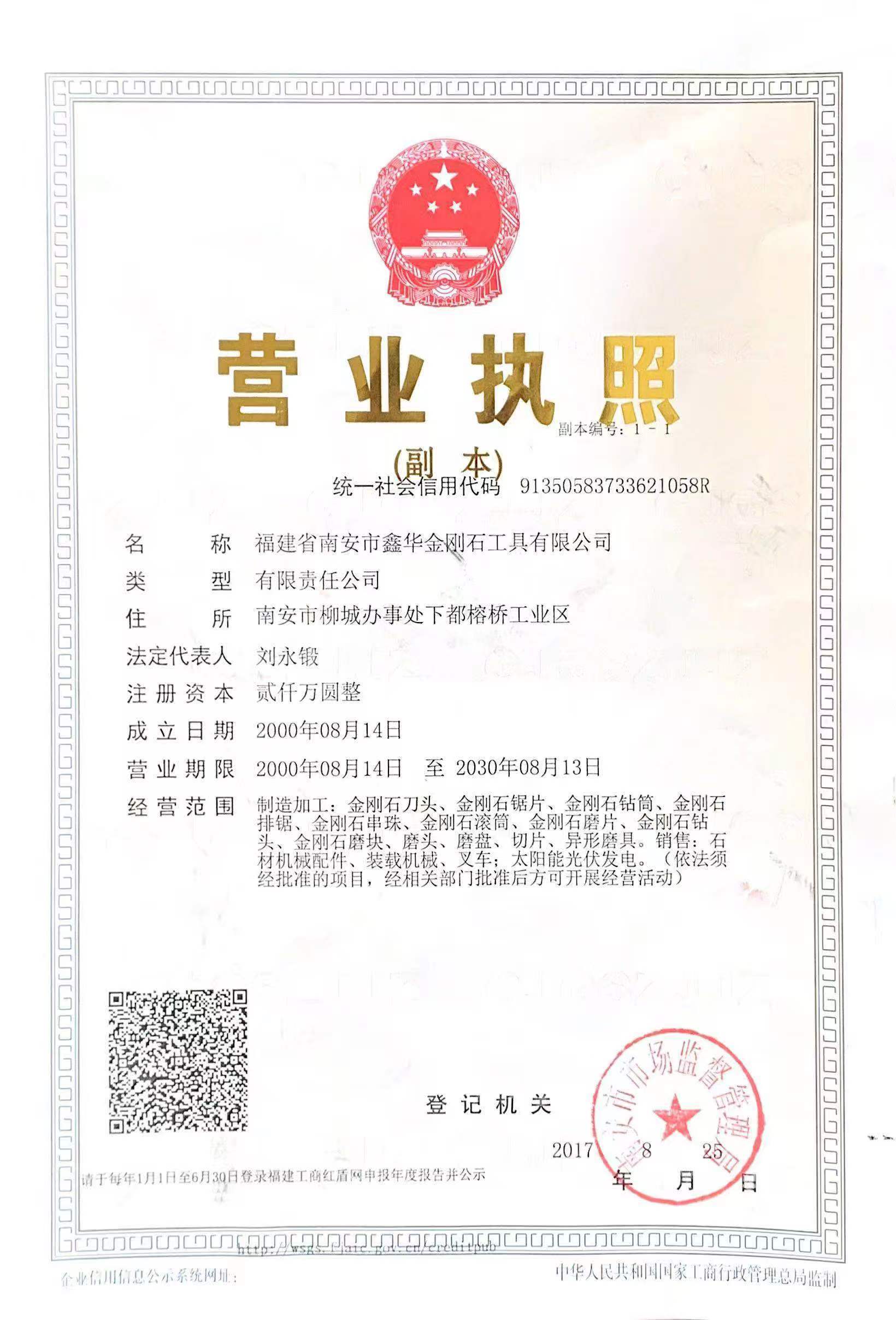
Fujian Nan'an Xinhua Diamond Tools Co., Ltd

Factors affecting the lifespan of diamond saw blades
The factors that affect the efficiency and lifespan of diamond circular saw blades include sawing process parameters, diamond particle size, concentration, and binder hardness. The sawing parameters include blade line speed, sawing concentration, and feed speed.
1、 Saw blade line speed: In practical work, the line speed of diamond circular saw blades is limited by equipment conditions, saw blade quality, and the nature of the stone being sawed. In terms of the optimal lifespan and cutting efficiency of the saw blade, the linear speed of the saw blade should be selected according to the properties of different stones. When sawing granite, the linear speed of the saw blade can be selected within the range of 25m-35m/s. For granite with high quartz content that is difficult to saw, it is advisable to set the lower limit of the saw blade line speed. When producing granite tiles, the diamond circular saw blade used has a smaller diameter and a line speed of up to 35m/s.
Sawing depth: Sawing depth is an important parameter related to diamond wear, effective sawing, blade stress, and the properties of the stone being sawed. Generally speaking, when the linear speed of the diamond circular saw blade is high, a small cutting depth should be selected. From current technology, the depth of sawing diamond can be selected between 1mm and 10mm. When using a large-diameter saw blade to cut granite blocks, the cutting depth can be controlled between 1mm and 2mm, and the feed speed should be reduced at the same time. When the linear velocity of the diamond circular saw blade is high, a larger cutting depth should be selected. But within the allowable range of sawing machine performance and tool strength, a higher cutting concentration should be taken as much as possible for cutting to improve cutting efficiency. When there are requirements for the machined surface, small depth cutting should be used.
Cutting speed: The cutting speed refers to the feed rate of the stone being sawed. Its size affects the cutting rate, blade force, and heat dissipation in the cutting area. Its value should be selected based on the properties of the stone being sawed. Generally speaking, when sawing softer stones such as marble, the cutting speed can be appropriately increased. If the cutting speed is too low, it is more conducive to improving the sawing rate. Sawing fine-grained structured and relatively homogeneous granite can increase the cutting speed appropriately. If the cutting speed is too low, the diamond blade is easily ground flat. When sawing granite with coarse grain structure and uneven hardness, the cutting speed should be reduced, otherwise it will cause blade vibration and diamond fragmentation, reducing the cutting rate. The cutting speed for sawing granite is generally selected within the range of 9m to 12m/min.
2、 Other influencing factors:
Diamond particle size: The commonly used diamond particle size ranges from 30/35 to 60/80. The harder the rock, the finer the particle size should be selected. Because under the same pressure conditions, diamonds become finer and sharper, which is beneficial for cutting into hard rocks. In addition, large diameter saw blades generally require high cutting efficiency, and it is advisable to choose coarser particle sizes such as 30/40, 40/50; Small diameter saw blades have low cutting efficiency and require smooth rock cutting sections. It is recommended to use finer particle sizes, such as 50/60 and 60/80.
Blade concentration: The so-called diamond concentration refers to the density of diamond distributed in the working layer matrix (i.e. the weight of diamond contained per unit area). According to the regulations, the concentration of 4.4 carats of diamond per cubic centimeter of working matrix is 100%, and the concentration of 3.3 carats of diamond is 75%. Volume concentration refers to the amount of volume occupied by diamond in the block, and it is specified that the concentration is 100% when the volume of diamond accounts for 1/4 of the total volume. Increasing the concentration of diamond is expected to prolong the lifespan of the saw blade, as increasing the concentration reduces the average cutting force per diamond grain. However, increasing the depth will inevitably increase the cost of the saw blade, so there is a most economical concentration that increases with the increase of the cutting rate.
3、 Hardness of blade bonding agent: Generally speaking, the higher the hardness of the bonding agent, the stronger its wear resistance. Therefore, when sawing rocks with high abrasive properties, the hardness of the binder should be high; When sawing soft rocks, the hardness of the binder should be low; When sawing and grinding hard and abrasive rocks, the hardness of the binder should be moderate
4、 Force effect, temperature effect, and abrasion damage: Diamond circular saw blades are subjected to alternating loads such as centrifugal force, cutting force, and cutting heat during the process of cutting stone. Diamond circular saw blades are worn and damaged due to force and temperature effects.
① Force effect: During the sawing process, the saw blade is subjected to axial and tangential forces. Due to the presence of forces in the circumferential and radial directions, the saw blade is wavy in the axial direction and disc-shaped in the radial direction. Both of these deformations can cause uneven rock sections, excessive waste of stone, loud sawing noise, and increased vibration, resulting in early damage to diamond clumps and reduced saw blade life.
② Temperature effect: Traditional theory suggests that the influence of temperature on the saw blade process is mainly manifested in two aspects: firstly, it leads to the graphitization of diamond in agglomerates; Secondly, it causes thermal stress between the diamond and the matrix, leading to premature detachment of diamond particles. New research shows that the heat generated during the cutting process is mainly transmitted to the agglomerates. The temperature in the arc zone is not high, generally between 40 and 120 ℃. However, the temperature at the grinding point of the abrasive grain is relatively high, generally between 250 and 700 ℃. The coolant only reduces the average temperature of the arc zone, but has a relatively small impact on the temperature of the abrasive particles. This temperature does not cause graphite carbonization, but it can change the friction performance between the abrasive particles and the workpiece, and cause thermal stress between the diamond and the additive, leading to fundamental bending of the diamond failure mechanism. Research has shown that temperature effect is the biggest factor affecting saw blade damage.
③ Wear and tear: Due to the effects of force and temperature, the saw blade often experiences wear and tear after a period of use. The main forms of wear and tear include abrasive wear, local fragmentation, large-scale fragmentation, detachment, and mechanical abrasion of the binder along the sawing speed direction. Abrasive wear: Diamond particles constantly rub against the workpiece, passivating the edges into flat surfaces, losing cutting performance, and increasing friction. Sawing heat can cause a thin layer of graphitization on the surface of diamond particles, greatly reducing their hardness and exacerbating wear. The surface of diamond particles is subjected to alternating thermal stress and cutting stress, resulting in fatigue cracks and local fragmentation, revealing sharp new edges, which is an ideal form of wear; Large scale fragmentation: Diamond particles bear impact loads during cutting and cutting, and prominent particles and grains are consumed prematurely; Detachment: The alternating cutting force causes the diamond particles to continuously shake and loosen in the binder. At the same time, the wear of the bonding agent itself and the cutting heat during the sawing process soften the bonding agent. This reduces the holding force of the binder, and when the cutting force on the particles is greater than the holding force, the diamond particles will fall off. Regardless of the type of wear, it is closely related to the load and temperature that diamond particles are subjected to. And both of these depend on the cutting process and cooling lubrication conditions.
previous page
previous page
CONTACT US
A professional manufacturer of superhard material tools that integrates scientific research, production, processing, sales, and trade.
Support hotline:
E-mail:
ADD:
Rongqiao Industrial Area, Nanan City, Fujian, China
Scan the code to follow!
Copyright Nanan Xinhua Diamond Tool Co. Ltd. All rights reserved. Powered by 300.cn Quanzhou | SEO Business License